
Desert dust and storms
Dust storms from March to June coat panels quickly. At Khavda, panels need cleaning several times a day in that season.
Desert dust, little rain and desalinated water: Kutch is where waterless cleaning makes the most sense. We bring Solar Glide and Aqualess to plants and warehouses from Gandhidham to Mundra.
Kutch has become one of India’s biggest industrial frontiers. Mundra is described as India’s largest commercial port, the district is home to the world’s largest maker of welded steel pipes, with big pipe plants at Anjar; the Kandla SEZ at Gandhidham houses more than 250 units, and the district has major cement and power plants.
That growth brings huge warehouses, sheds and logistics parks: exactly the roofs that carry big solar arrays.
It also brings the hardest conditions for keeping panels clean. Kutch gets only about 350 mm of rain in a typical year and suffers regular droughts. At the Khavda renewable energy park, dust storms from March to June mean panels need cleaning several times a day, and the whole 30 GW park is being designed around waterless robotic cleaning. Mundra’s industrial hub runs entirely on desalinated and treated water.
Factories, warehouses and plants with rooftop solar in these estates and corridors.
Kutch’s own mega solar park has chosen waterless robotic cleaning for the same reasons.
Dust storms from March to June coat panels quickly. At Khavda, panels need cleaning several times a day in that season.
About 350 mm in a typical year, and frequent droughts, so rain almost never cleans the glass.
Groundwater is falling fast, and major hubs rely on desalination. Every litre used on panels has a real cost.
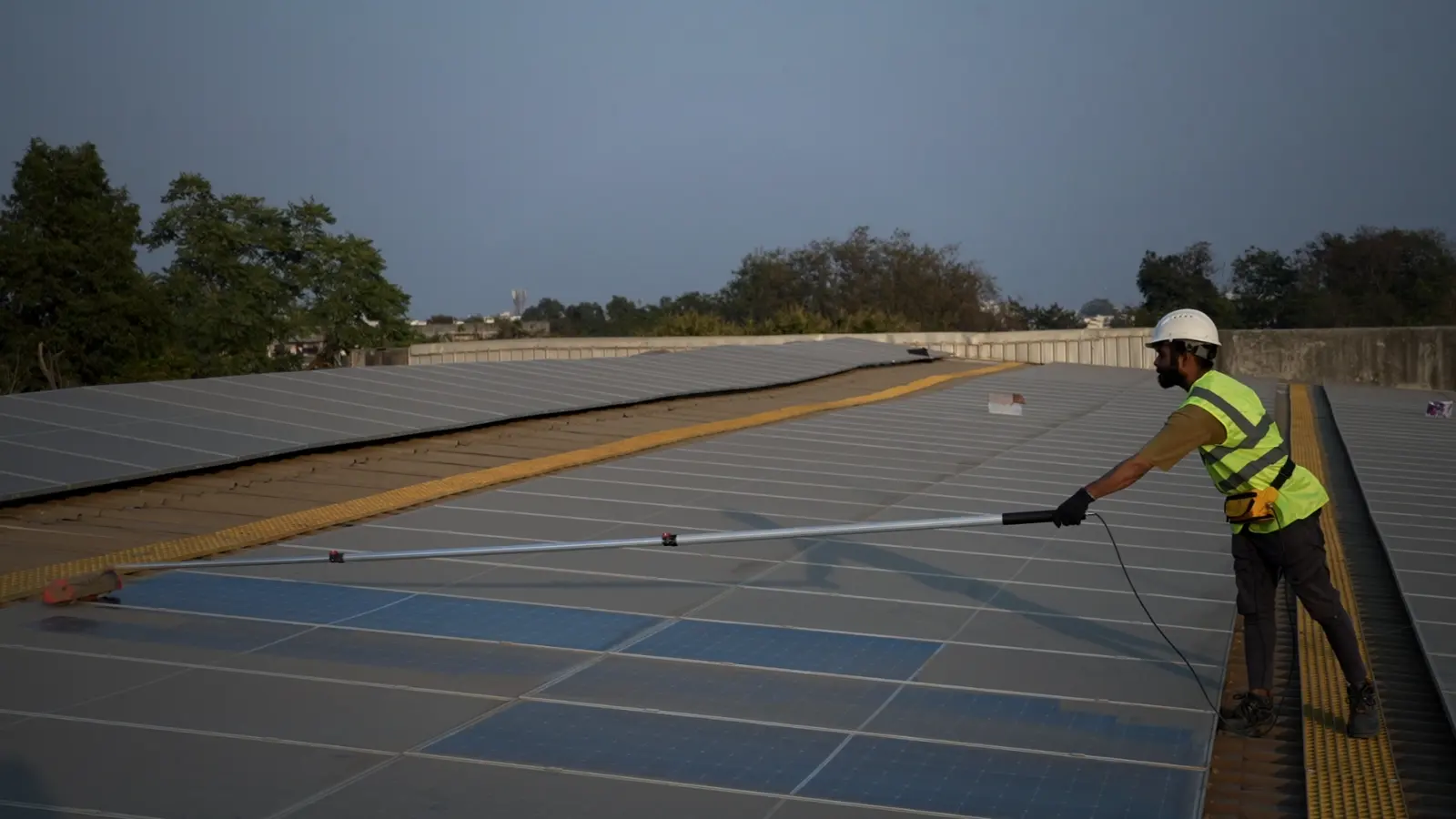
Large factory sheds and warehouses with long, continuous panel rows suit Solar Glide. The robot travels along the row with a dry rotating brush, charges itself from its own solar panel and runs on a schedule, so nobody has to walk the roof.
Roofs with several smaller arrays, skylights, vents or mixed orientations suit Aqualess Industrial: a 600 mm motorised brush on a 3.3 m rod that one person guides from a safe position.
Both clean dry. In a district where industry depends on desalinated water, dry cleaning is the obvious choice.
Our team travels from Vadodara (~400 km to Gandhidham) to survey your roof, demonstrate the cleaner on your own panels and set it up. Support continues after handover.
Yes. We supply Solar Glide robots and Aqualess waterless cleaners across Kutch, including Kandla SEZ, Mundra, Anjar and Bhuj, and we visit for a roof survey, demo, setup and support.
Solar Glide can run on a schedule, so after a dust storm it can clean again without waiting for a crew. That matters in a season when panels can need cleaning more than once a day.
We are based in Makarpura GIDC, Vadodara, about 400 km away by road. We travel across Gujarat for roof surveys, demos, setup and support. Call or message us to book a visit.
A wet clean typically uses 3–5 litres per panel each time, and 7–8 litres in arid areas like Kutch, according to CEEW. Here that water is often desalinated. Our savings calculator shows the yearly figure.
Running rooftop solar in Kutch? Book a site visit and see a waterless clean on your own panels.
Book a site visit →