
Clay and glaze dust
Ceramic production handles clay, silica and glaze powders. Fine dust from the plants and from truck traffic settles on nearby roofs.
Morbi makes most of India’s ceramic tiles, and its factory roofs carry some of the dustiest solar arrays in Gujarat. Clean them dry, as often as they need it, without a water tanker.
Morbi is the heart of India’s ceramics industry. The Gujarat government counts about 1,200 ceramic units here, producing about 60 lakh tonnes a year and 80–90% of India’s ceramic exports. Wall clocks and PP woven fabric are big local industries too.
Ceramic plants run kilns, dryers and presses around the clock, so they use a lot of power, and their wide sheds have plenty of roof for solar. A new ceramic industrial park of about 1,050 acres is coming up at Jambudiya–Paneli.
Reporters describe Morbi’s air as thick with grit. Clay and glaze dust from the factories, and from the trucks that serve them, lands on every roof, so panels here need cleaning more often than in most towns. Saurashtra’s dry climate means rain rarely does the job.
Factories, warehouses and plants with rooftop solar in these estates and corridors.
Ceramic production handles clay, silica and glaze powders. Fine dust from the plants and from truck traffic settles on nearby roofs.
Little rain for most of the year means the dust is never rinsed away naturally.
Kilns and presses run day and night, so every percent of solar output lost to dust is power bought from the grid.
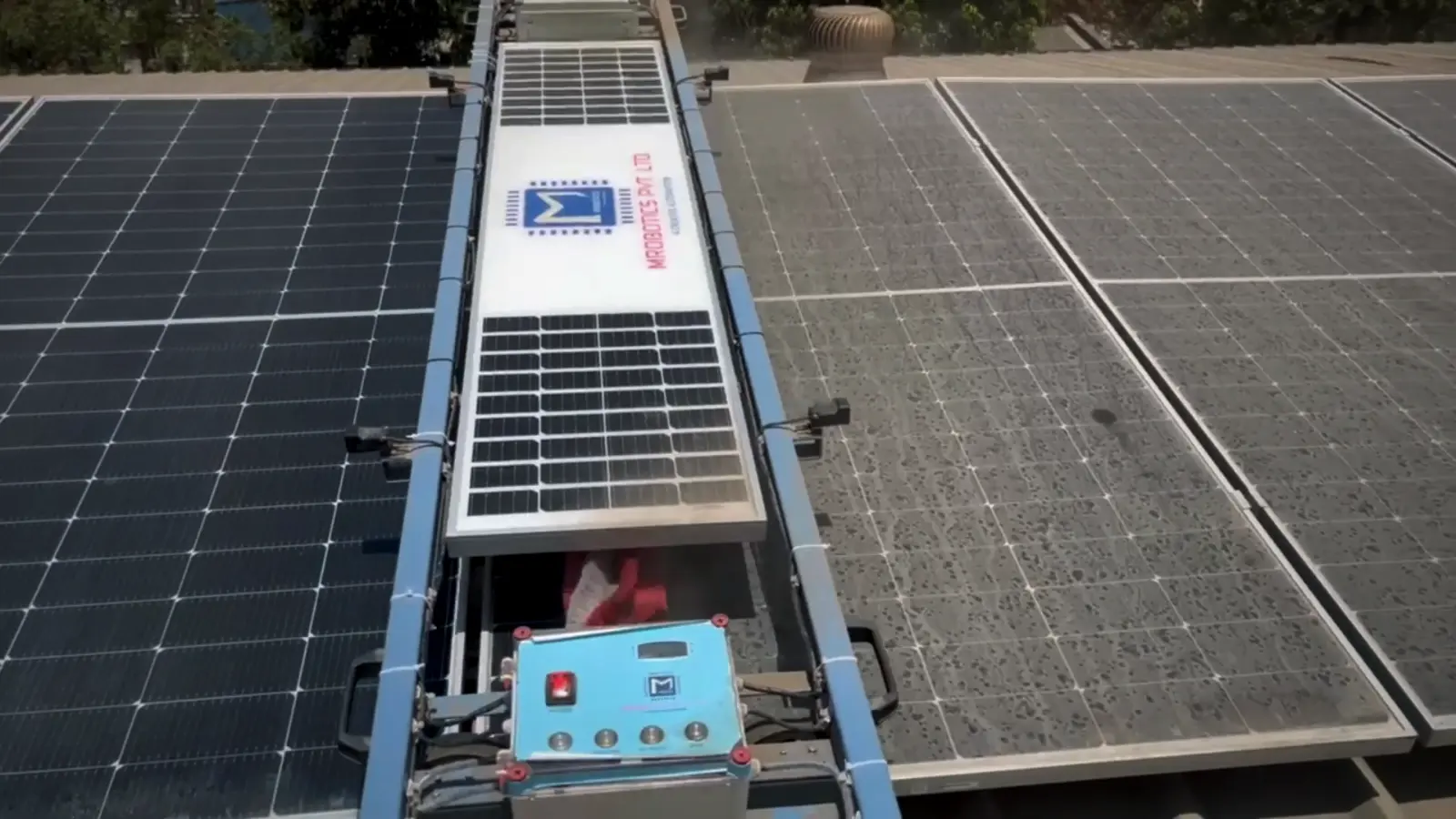
Large factory sheds and warehouses with long, continuous panel rows suit Solar Glide. The robot travels along the row with a dry rotating brush, charges itself from its own solar panel and runs on a schedule, so nobody has to walk the roof.
Roofs with several smaller arrays, skylights, vents or mixed orientations suit Aqualess Industrial: a 600 mm motorised brush on a 3.3 m rod that one person guides from a safe position.
Both clean dry. In a dusty town where panels need frequent cleaning, going waterless removes the tanker bill entirely.
Our team travels from Vadodara (~310 km) to survey your roof, demonstrate the cleaner on your own panels and set it up. Support continues after handover.
Yes. We supply Solar Glide robots and Aqualess waterless cleaners to factories across the Morbi–Wankaner belt, and we visit for a roof survey, demo, setup and support.
In a heavy-dust area, panels can lose output within days. Solar Glide can run on an automatic schedule, so you can clean as often as the dust demands without extra labour or water.
We are based in Makarpura GIDC, Vadodara, about 310 km away by road. We travel across Gujarat for roof surveys, demos, setup and support. Call or message us to book a visit.
A wet clean typically uses 3–5 litres per panel each time, according to CEEW. Cleaning often in a dusty area multiplies that. Our savings calculator shows the yearly saving for your plant.
Running rooftop solar in Morbi? Book a site visit and see a waterless clean on your own panels.
Book a site visit →